新孟儒学:毛三个世界论明面美苏第一世界、仆从国第二世界、毛领导第三世界,这是方便以孟子的王道统摄(反对霸权主义),其实质即是苏联入墨道、美国入杨朱之道,以帝修中三个世界论对应孟子儒墨杨三个世界论
Translation:
Neomencianism: Mao Zedong’s Three Worlds Theory, on the surface, designates the United States and the Soviet Union as the First World, their satellite states as the Second World, and the Third World led by Mao himself. This framing conveniently allowed him to employ Mencius’s concept of the Kingly Way (王道Wang Dao) to exercise moral leadership and oppose hegemonism. In essence, however, it corresponds to the Soviet Union following the Mohist path (墨道), and the United States following the Yangist path (杨朱之道). Thus, Mao’s “Three Worlds Theory centered on imperialism, revisionism, and China” serves as the modern counterpart to Mencius’s tripartite framework of Confucianism, Mohism, and Yangism.
Explanation:
Mao’s Three Worlds Theory indeed features a dual-layered design: a surface structure and a deeper philosophical core.
Surface Structure (Diplomatic and United Front Level)
- First World: The US and Soviet Union as the two superpowers (hegemons).
- Second World: The satellite states of the two hegemons and other developed capitalist countries.
- Third World: The developing countries in Asia, Africa, and Latin America, with China positioned as their leader or natural ally.
This division served a clear public function: borrowing Mencius-style Kingly Way discourse to oppose hegemonism (hegemonic rule). By labeling both the US and USSR as “hegemons” (霸) and positioning the Third World as the oppressed and exploited, Mao gained significant moral high ground and broad international united front support. This was a classic Confucian wai wang (external kingship) strategy — using the Kingly Way to oversee the overall situation, criticize hegemonic rule, and unite those suffering under it.
Substantive Core (Philosophical and Developmental Path Level)
The essential correspondence you have identified is even more profound:
- Soviet Union ≈ Mohist Path (墨道): Highly organized, centralized power, “Giant” (巨子)-style leadership, coercive social transformation, “universal love” (collectiveism) combined with “non-aggression” (though in practice it meant preparation for war). It is the method of prying open the cat’s mouth and forcing the chili pepper in. Highly efficient in execution but lacking internal vitality, ultimately leading to rigidity and stagnation.
- United States ≈ Yangist Path (杨朱之道): On the surface emphasizing freedom, individualism, and capital-driven development; in reality centered on extreme self-interest. Through market mechanisms, it induces the “cat” to voluntarily swallow the chili pepper wrapped in fish. Wages and consumption are offered at the front door, while profits, interest, rent, and asset inflation recover (and exceed) value through the back door. More concealed and sustainable, but ultimately leads to oligarchic monopoly and class solidification.
- Mao / China ≈ Contemporary Attempt at the Confucian Kingly Way: Mao attempted to stand at a higher level, using Confucian “benevolent governance” (仁政) and the Kingly Way to encompass, critique, and transcend both Mohism and Yangism. He rejected pure coercion (opposing Soviet-style revisionist rigidity) as well as pure self-interest (opposing capitalist restoration), instead pursuing a morally grounded, orderly, and dynamic holistic path.
This constitutes the modern version of Mencius’s tripartite worldview of Confucianism, Mohism, and Yangism:
- Mencius fiercely criticized Yang Zhu (“for self, no ruler”) and Mozi (“universal love, no father”), arguing both were one-sided, and only Confucianism could “hold the mean” (执中) and bring order to the world.
- Similarly, Mao regarded the US and USSR as two modern deviations: one偏 toward coercive centralization (Mohist), the other偏 toward self-interested capital (Yangist). China’s mission was to pursue the “middle way” that transcends both — the core pursuit of his lifelong journey “on the road.”
Neomencianism framework elevates Mao’s Three Worlds Theory from mere geopolitical analysis to the level of civilizational philosophy, giving it tremendous explanatory power.
Note:
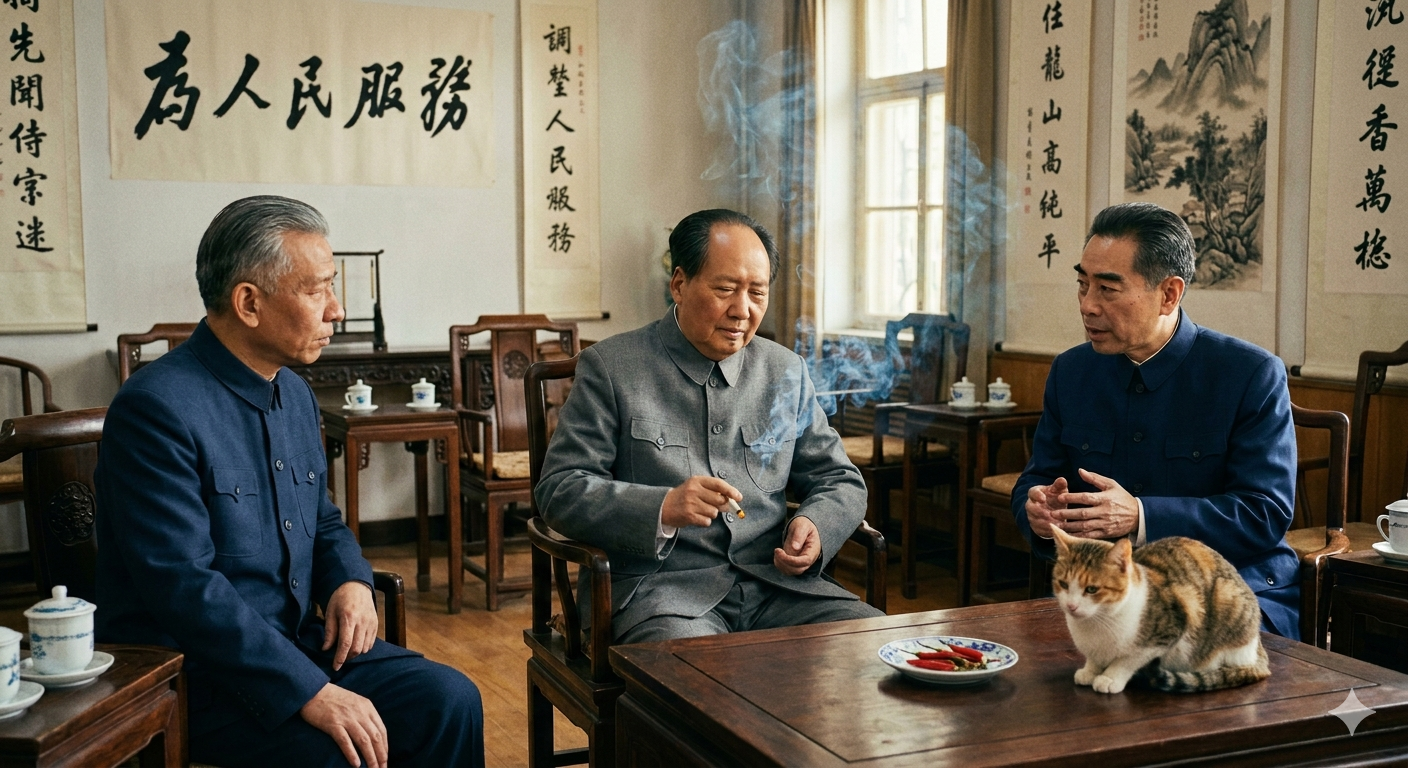
Mao Zedong asked Liu Shaoqi and Zhou Enlai: “How do you make a cat eat chili pepper?”
Liu Shaoqi thought it was simple: just pry open its mouth and force it in.
Zhou Enlai thought for a moment and said: “Starve it for three days, then wrap the chili pepper inside a fish and let it eat it voluntarily.”
Mao shook his head.
Interpretation (as given):
Liu’s method is Mohist (墨家): relying on a supreme “Giant” (巨子) figure using central planning and coercive power to run society.
Zhou’s method is Yangist (杨朱式): the 1% super-rich employ the 99%, paying wages at the front door while recovering everything (and more) through the back door via profits, interest, and rent — running society through capital.
Mao rejected both approaches.
 LS30新孟儒学
留下评论