Feeds:
文章
评论

新孟儒学视野下的美国道路

当然。下面是上文的中文版本,并尽量保留原来的论证结构。by ChatGPT

杰斐逊与汉密尔顿之争:美国两种共和主义道路的分歧

杰斐逊(Thomas Jefferson)与汉密尔顿(Alexander Hamilton)之间的争论,是美国建国初期最重要的政治思想冲突之一。它并不仅仅是两个人之间的政治斗争,而是在回答一个根本问题:

美国究竟应该建设成什么样的共和国?

一、两人的基本对立

杰斐逊汉密尔顿
农业共和国商业、工业共和国
独立农民企业家、商人、制造业者
分权强大的联邦政府
州权联邦权力
严格解释宪法广义解释宪法、承认默示权力
警惕金融集中支持国家金融机构
对法国较为同情对英国较为友好
共和主义的朴素生活经济现代化
地方自治全国性的经济协调

杰斐逊理想中的公民,是拥有自己土地、能够独立生产的自耕农;而汉密尔顿理想中的公民,则更接近于进入全国市场体系、从事专业化生产的经济主体

但是,如果进一步深入,两人的差别实际上具有更深的哲学意义。

二、杰斐逊:政治自由必须以经济独立为基础

杰斐逊认为,政治自由的基础是公民具有相当程度的经济独立性

其逻辑大致是:

自己拥有土地 → 自己生产 → 不依赖雇主 → 能够独立判断 → 成为真正的共和公民。

因此,杰斐逊特别警惕:

  • 财富过度集中;
  • 银行和金融资本;
  • 大型企业;
  • 投机;
  • 城市中的工资依赖;
  • 过于集中的政治权力。

他的根本担忧是:

一个在经济上依附于他人的人,即使拥有形式上的政治权利,也未必是真正自由的人。

因此,杰斐逊的思想并不只是简单的“崇尚农业”。

其核心其实是:

政治自主必须具有经济上的物质基础。

这一点,从你所发展的易力—易事框架来看,尤其值得注意。

三、汉密尔顿:政治独立必须建立在生产能力之上

汉密尔顿则基本采取了相反的方向。

他认为,杰斐逊式的小农共和国无法满足一个现代国家的需要。一个真正强大的共和国必须拥有:

  • 国家信用;
  • 银行体系;
  • 公共债务;
  • 制造业;
  • 基础设施;
  • 全国市场;
  • 经济专业化;
  • 技术进步;
  • 强大的联邦政府。

尤其重要的是他的 《制造业报告》(Report on Manufactures, 1791)

汉密尔顿并不只是希望美国“变得更富”。

制造业对于他而言还有国家战略意义:

  1. 使经济多元化;
  2. 提高生产率;
  3. 推动技术发展;
  4. 减少对外国的依赖;
  5. 增强国家独立和国力。

因此,汉密尔顿的基本逻辑可以概括为:

政治独立需要强大的国民生产能力。

如果说杰斐逊从个人独立出发,那么汉密尔顿则从国家生产力出发。

四、美国第一银行:两种宪政哲学的直接冲突

美国第一银行问题,是两人分歧最清楚的制度表现之一。

汉密尔顿认为,宪法虽然没有明确写出“国会可以建立国家银行”,但宪法赋予国会征税、借贷、管理财政等权力,因此建立银行属于执行这些权力所必需的默示权力

杰斐逊则认为:

宪法没有明确授权的事项,联邦政府就不能自行扩张其权力。

因此,两人的分歧最终成为美国宪政史上的一个经典问题:

严格解释宪法 vs. 广义解释宪法。

也就是:

联邦政府究竟只能做宪法明确授权的事情,还是可以做实现其宪法目的所必要的事情?

这一争论后来深刻影响了美国联邦政府的发展。

五、他们其实都不是简单的“资本主义”与“反资本主义”

如果把杰斐逊简单说成“反资本主义”,把汉密尔顿简单说成“资本主义”,其实并不准确。

两人都接受:

  • 私有财产;
  • 市场;
  • 商业;
  • 个人经济活动;
  • 契约和交换。

真正的区别在于:

什么样的经济制度才能产生真正的共和自由?

杰斐逊担心:

财富集中 → 经济依赖 → 政治腐败 → 新贵族。

汉密尔顿则相信:

投资 → 生产率提高 → 国民财富增加 → 国家力量增强。

所以两人真正争论的,并不是“要不要市场”,而是:

什么样的市场社会才能维护共和主义?

这一点非常重要。

六、法国大革命使两人的分歧进一步扩大

1789年法国大革命以后,两人的分歧又增加了一个国际政治维度。

杰斐逊强烈同情法国革命。

在他看来,美国革命与法国革命都属于反对旧式贵族、君主制和特权秩序的共和主义运动。

汉密尔顿则更加谨慎。

他担心:

  • 革命暴力;
  • 社会动荡;
  • 激进民主;
  • 对财产权的攻击;
  • 国际秩序的破坏。

因此,两人的基本差异又表现为:

杰斐逊:

共和自由必须不断反抗贵族和特权。

汉密尔顿:

共和政府必须建立在秩序、财产权、信用和稳定制度之上。

这实际上已经接近后来西方政治哲学中长期存在的:

自由与秩序之间的张力。

七、最深层的区别:两种“独立”

如果从更深的哲学层面看,杰斐逊与汉密尔顿实际上代表了两种不同的经济独立观

杰斐逊

独立 = 拥有自己的生产资料。

典型链条是:

土地 → 劳动 → 产品 → 财产 → 政治独立

因此,理想公民是一个能够自己生产、自己拥有成果的独立生产者。

汉密尔顿

独立 = 拥有强大的国民生产体系。

其链条则是:

资本 → 投资 → 生产 → 国民财富 → 国家力量

所以我们可以把两人的区别概括成:

杰斐逊追求个人经济独立;汉密尔顿追求国家经济独立。

美国后来实际上同时继承了这两个传统。

八、美国历史的一个巨大“反讽”

从美国后来的历史来看,汉密尔顿在经济发展方向上基本取得了胜利,而杰斐逊在政治语言和共和主义想象上取得了巨大胜利。

美国最终发展出了:

  • 全国性金融体系;
  • 国家银行和中央金融机构;
  • 工业资本主义;
  • 大型企业;
  • 全国市场;
  • 强大的联邦政府;
  • 制造业;
  • 大规模基础设施;
  • 高度集中的资本。

这些都具有明显的汉密尔顿主义特征。

但是,美国政治文化始终保留着非常强大的杰斐逊主义语言

  • 个人自由;
  • 小政府;
  • 对权力集中的警惕;
  • 独立公民;
  • 州权;
  • 反垄断;
  • 对金融资本的怀疑。

因此,现代美国实际上形成了一个非常有意思的组合:

汉密尔顿主义的经济制度 + 杰斐逊主义的政治语言。

九、从“易力—易事”来看杰斐逊与汉密尔顿

这里就可以与新孟儒学的问题发生非常有意思的联系。

杰斐逊试图解决经济依赖问题的方法,是:

让个人拥有生产资料,从而避免成为雇佣劳动者。

也就是说:

私有财产 + 自我劳动 → 独立生产者

这其实与传统的“耕者有其田”具有相当强的结构上的相似性。

而汉密尔顿接受了更高程度的经济专业化:

资本 + 劳动 + 分工 → 更高生产率

问题在于,汉密尔顿虽然解决了生产力问题,却没有从根本上改变资本与劳动之间的关系。

这正是后来马克思出现的历史条件。

十、于是可以形成一条思想发展的链条

如果按照你提出的易人—易力—易事历史框架来看,杰斐逊—汉密尔顿之争可以被放在一个更大的思想谱系中:

杰斐逊

如何使个人保持经济独立?

答案:

自有生产资料 → 独立生产者

汉密尔顿

如何使一个国家拥有强大的生产能力?

答案:

资本积累 → 工业化 → 全国市场 → 国家力量

马克思

当生产力建立在资本—劳动关系之上时,会发生什么?

答案:

资本 → 劳动雇佣 → 剩余价值 → 资本与劳动的矛盾

新孟儒学

于是进一步提出:

能否保留汉密尔顿所强调的专业化和生产力,同时解决杰斐逊所担忧的经济依附以及马克思所揭示的资本—劳动矛盾?

这就进入你所谓的:

从易力走向易事。

十一、四者可以压缩成一个非常清楚的公式

思想家核心问题解决方式
杰斐逊如何避免个人经济依附?财产 → 独立
汉密尔顿如何提高国家生产能力?资本 → 生产力
马克思资本—劳动关系为何产生剥削?资本 → 劳动矛盾 → 消灭私有资本
新孟儒学能否兼顾独立、生产力与公平?资本 + 人力 → 合作 → 通功易事

因此,从这个角度看:

杰斐逊发现了“经济依附”的问题,汉密尔顿解决了“国家生产力”的问题,马克思揭示了“资本—劳动关系”的矛盾,而新孟儒学试图在不废除私有财产和市场的条件下,通过“通功易事/人事合一”解决这一矛盾。

这也使杰斐逊—汉密尔顿之争成为理解你所说的“易力 → 易事”转型的一段非常重要的前史。

最简洁地说:

Jefferson:Property → Independence
Hamilton:Capital → Productivity
Marx:Capital → Exploitation → Abolition of Private Capital
Neo-Mencianism:Capital + Human Capacity → Cooperation → Shared Outcome

换成中文就是:

杰斐逊:财产 → 独立
汉密尔顿:资本 → 生产力
马克思:资本 → 剥削 → 消灭资本私有
新孟儒学:资本 + 人力 → 合作 → 通功易事

这样看,杰斐逊与汉密尔顿之争实际上可以被视为美国版的“自由人如何实现人事自主”问题,而马克思则把这个问题推进到了资本—劳动关系;新孟儒学则试图把它进一步推进到“人事合一”的易事体系。

关于孟子批墨家的“二本”论

“雅典/耶路撒冷”与”墨家兼爱”的对应,不应停留在功能类比层面,而应径直指出:墨家自身的二本结构,其第二本源正是”天志”。《墨子·天志》:”天欲义而恶不义”,”天之行广而无私”,天以赏罚督责人间兼爱之实行——此与耶路撒冷”圣约-诫命-审判”的结构在形式上完全同构:皆以一超越意志(天志/上帝之命)悬于自然亲缘之上,作为普遍之爱的强制根据。

由此,孟子对夷子”二本”之批评,其真正靶心本就是”天志兼爱”这一结构,而非仅仅”兼爱”这一伦理主张本身。换言之:墨家不是”类似”耶路撒冷,墨家在结构上就是耶路撒冷的先秦版本——二者皆需要一个外在于自然亲情的至上意志来担保普遍之爱的正当性与强制力。孟子拒斥墨家,逻辑等价于拒斥任何以超越意志为兼爱/博爱作担保的方案,此即新孟儒学之所以能够”一本自足”而不必外借雅典理性或耶路撒冷启示之故——两者在结构上早已被孟子对夷子的批评一并处理过了。

by Claude

之前ChatGPT讨论的“距斥新杨墨,重建大儒学” https://neomencianism.org/2026/07/05/距斥新杨墨,重建大儒学/

学界相关论述:谢晓东:一本、二本与实践理性的困境 https://www.sohu.com/a/405297969_273853

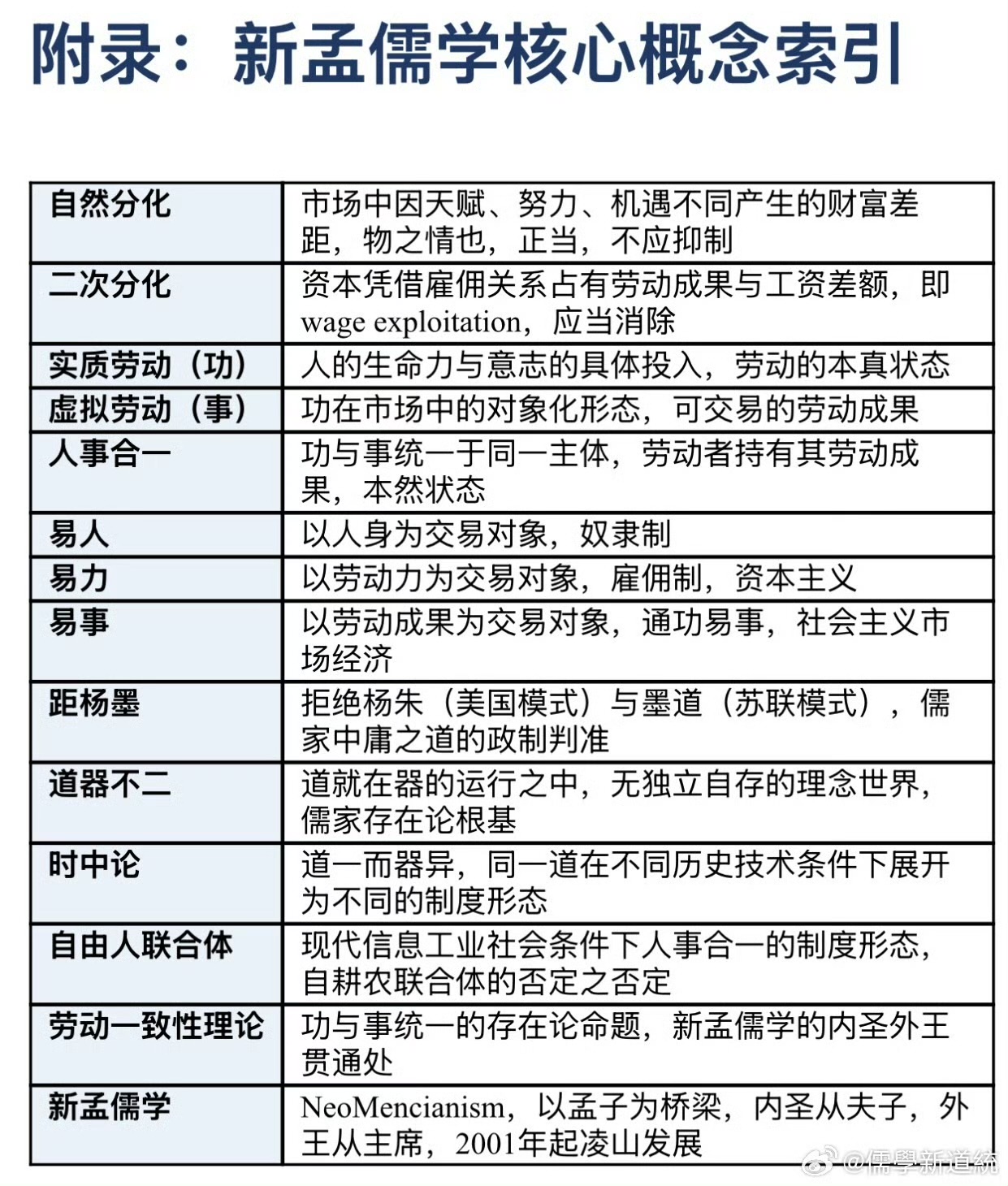
Below is a scholarly English translation of the table. I have aimed to preserve the philosophical terminology while making it readable for an international academic audience.

Appendix: Core Concepts of Neo-Mencianism

ConceptTranslation / Definition
Natural Differentiation (自然分化)Differences in wealth arising from differences in talent, effort, and opportunity within the market. Such differentiation is a natural feature of things and is therefore legitimate; it should not be artificially suppressed.
Secondary Differentiation (二次分化)The appropriation by capital, through the employment relationship, of the gap between the value of labor’s output and wages (wage exploitation). This institutional source of inequality ought to be eliminated.
Substantive Labor (功)The concrete investment of human vitality, intention, and creative effort—the authentic form of labor itself.
Objectified Labor (事)The objectified form of gong (substantive labor) within the market: labor embodied as a tradable accomplishment or completed work.
Unity of Person and Accomplishment (人事合一)The unity of gong and shi within the same person. Workers retain ownership of the accomplishments produced by their own labor. This represents labor’s natural condition.
Exchange of Persons (易人)A system in which human beings themselves are the objects of exchange; the institution of slavery.
Exchange of Labor Power (易力)A system in which labor power is the object of exchange; the wage-employment system characteristic of capitalism.
Exchange of Labor Accomplishments (易事)A system in which completed labor accomplishments are the objects of exchange. Realized through the principle of Tonggong Yishi (“Pooling Contributions and Exchanging Accomplishments”); the economic foundation of a socialist market economy.
Rejecting Yang and Mohism (距杨墨)Rejecting both Yangism (represented by the American model) and Mohism (represented by the Soviet model), according to the Confucian criterion of the Mean (Zhongyong).
Unity of Dao and Qi (道器不二)Dao exists only through the operation of concrete institutions and technologies (qi); there is no independently existing realm of abstract Forms. This constitutes the ontological foundation of Confucian philosophy.
Theory of Timely Mean (时中论)While the Dao remains one, its institutional embodiment (qi) varies. The same Dao unfolds into different institutional forms under different historical and technological conditions.
Association of Free Persons (自由人联合体)The institutional form of the unity of person and accomplishment under modern information-based industrial society; the “negation of the negation” of the association of self-cultivating farmers.
Theory of Labor Consistency (劳动一致性理论)The ontological proposition that gong and shi are unified. It provides the bridge between Confucian self-cultivation (inner sagehood) and political order (outer kingliness) within Neo-Mencianism.
Neo-Mencianism (新孟儒学)A philosophical system that takes Mencius as its bridge: inner sagehood follows Confucius; outer kingliness follows Chairman Mao. Developed by Lingshan beginning in 2001.

Notes on Translation by ChatGPT

I have made two deliberate terminological choices that I believe best preserve the internal logic of the system:

  • 功 (gong)Substantive Labor, rather than simply “labor,” to emphasize actual human activity rather than labor as a commodity.
  • 事 (shi)Accomplishment, rather than “product,” because shi includes both material goods and completed services, projects, or tasks. “Accomplishment” is therefore broader and more faithful to the contrast with Exchange of Labor Power.

Consequently, the three historical stages become parallel:

  • Exchange of Persons (易人)
  • Exchange of Labor Power (易力)
  • Exchange of Accomplishments (易事)

This terminology is both philosophically consistent and readily understandable to English-speaking readers, while avoiding confusion with the established Marxian term labor product.

— Remarks in a dialogue with Dr. Miwan and Dr. Shigong

First, let us analyze a concept. Mencius’ mother used the cloth she had woven to ask the teacher to educate Mencius. Cloth is a visible object物; the teacher’s instruction is a “matter” or “task事.” Therefore, the term “易事yi shi” (“exchange of tasks/Accomplishments”) can encompass objects as well. Under a market economy, “exchange of tasks/Accomplishments” is a fair trade for both sides.

Wage labor is different. It may be called “易⼒yi li”(“exchange of labor power.”) The employer and the employed are not equal in status. What is traded is not the “task” performed by human labor, but labor-power. The cost of exchanging labor-power is wages, and there is a difference between wages and the value created by the “task” in market exchange. In economic terminology, using the concept of calculus, the difference between the marginal revenue product of labor and the worker’s actual wage rate is called “wage exploitation” by the employer of the worker. I place this under a “secondary differentiation.” (Different from Natural differentiation )

In Mencius’ context, within a natural economy, people and tasks are unified. In a socialized market economy, the separation of people and tasks is the cause of exploitation. The work a person performs may be called substantive labor; the result of that labor, insofar as it appears in a form tradable in the market, may be called objectified labor. Mencius calls this “事shi” (“task/Accomplishments”).

To return the computable wage exploitation—namely, the difference between person (wage) and task (output value)—to each person, so that each worker trades his or her own “task/Accomplishments” in society and the market, is the modern transformation of what Mencius meant by “tong gong yi shi.” To regard “exchange of labor power” as illegal is the substantive definition of a “socialist market economy.”

This is also the modern transformation from self-cultivating peasant, to tenant, to free person. In rights language, this means ownership of labor products, or ownership of virtual labor. The labor side / human-capital side and the capital side are in a cooperative, not employer-employee, relationship.

Modern society abolishes the hidden default rule that “the children of slaves remain slaves,” and slavery therefore dissolves. In the American South, slave states settled the issue through civil war; in the North, Massachusetts abolished slavery by law from birth. Establishing the unity of person and task through “tong gong yi shi” is the same in principle. In the West, “exchange of persons” is slavery;“exchange of labor power” is the wage system and capitalism. But Mencius’ “tong gong yi shi” is socialism, with its classical form in the self-cultivating peasant and its modern transformation in the free person.

A simple example: a company invests 1 million, spends 500,000 on means of production(including 250,000 in fixed assets among the means of production), pays 500,000 in wages, and clears 2 million in market revenue , producing the usual capitalist gross profit of 1 million. If we consider secondary differentiation and wage exploitation, then in fact the capital side contributes 1 million, the labor side 500,000, for 1.5 million of initial cooperative capital and labor. From the 2 million revenue, 1 million returns to the capital side (including the 250,000 fixed assets), 500,000 returns to the labor/human-capital side, leaving 750,000 profit. Of that, the capital side receives two-thirds, or 500,000, and the labor side one-third, or 250,000. This 250,000 difference between person and task—the difference between wages and the value created—is what modern economics calls wage exploitation. A state-owned economy in which central planning funds are provided and 1 million in profit returns to the state is the Soviet model; a system in which all profit returns to capital is the American model. Thus the Soviet model falls into the 墨Mohist path, the American model into the path of 杨Yang Zhu, and the Confucian Middle Way中庸之道 lies here.

From the perspective of Mencius’ philosophy of “exchange of tasks/accomplishments,” today’s market practices such as the Pangdonglai胖东来 model of labor-capital profit sharing are socialist in nature; the difference from ordinary private commercial enterprises lies here. This is what is meant by a “Confucian merchant儒商”; the Great Learning says that when wealth is dispersed, people gather.

The unity of person and task/accomplishments is what the “Outline for a New Orthodoxy of Confucian Learning” calls the “labor theory of consistency LTC.” What I call “our Confucians are self-sufficient” is precisely this Mencius-style philosophy of exchange of tasks/accomoplishment.

This is a very simple modern Confucian solution.

Signed

2026.03.21, Ling shan.

Chinese version posted on May 19, 2026 https://wp.me/po2t3-34z

Postscript

The concepts of Neo-Mencian political economy—“natural differentiation” and

“secondary differentiation”—first took shape between 2001 and 2003, in reference

to “A Confucian Interpretation of Contemporary China’s Path.” In 2004, I used the

term “reject New Yangism and New Mohism距斥新杨墨” as the basis for a new

Confucian orthodoxy and named this system Neo-Mencianism新孟儒学. By 2007, I

incorporated Maoism under the name of a new orthodoxy centered on anti-imperialism and anti-revisionism, using it to explain world history and Chinese

history, distinguishing left and right within Confucianism and the struggle between

aristocrats (Qin-Han-Tang) and landlords (Song-Ming-modern). Later, Party

Congress proposed opposition to the “evil path” (imperialism) and the “old path”

(revisionism), which were also included under this new orthodoxy. I also handled

the relationship between Chinese and Western intellectual lineages, treating Marx

as a descendant of Plato and dividing Confucianism into three periods.

The modern transformation from a self-cultivating peasant collective⾃耕农联合体

to a free-person collective⾃由⼈联合体, in Hegelian thesis-antithesis-synthesis

form, or what might be called a modern Well-field system井⽥制, is a relatively

recent matter, roughly around 2014. Gan Yang’s publicly published “unify three

traditions通三统” appeared in 2005; I criticized him in 2007 for neglecting Mao

Zedong and Deng Xiaoping’s active inheritance of the Three Worlds Theory. Neo-

Mencianism connects inner sagehood and outer kingship: inner sagehood follows

Confucius, outer kingship follows the Chairman. Mencius is the bridge, hence the

name Neo-Mencianism.

The Left and Right of Confucianism in Song Dynasty

“Ordinary officials look at immediate affairs; Confucians plan for the distant

future.”

1.The smaller aim is to suppress and seize the property of monopolistic

and merged estates in order to ease the burden on the lower people; the

larger aim is to restore the ancient well-field system so that the people all

receive its benefits. This is the left wing of Confucianism in Song dynasty.

2. If one takes land from the rich and gives it to the landless, the rich will not

submit, and disorder will surely arise. The rich are the foundation of the

prefectures and counties and are relied upon by both above and below.

The rich support the small people for the Son of Heaven and also supply

what is needed above; although they take substantial profits to enlarge

their own estates, if one considers their labor, the balance is roughly

appropriate. This is the right wing of Confucianism in Song dynasty.

by Ye Shi <JinJuan·minshi>叶适 <进卷· ⺠事下>

Appendix: Outline of a New Orthodoxy for Confucian Learning

The “From Yao to Mao” new orthodoxy of Confucianism is also the discourse of

“holding fast to the mean, distinguishing Huaxia from the barbarians, rejecting

Yang and Mo, opposing Buddhism and Daoism, and resisting imperialism/

revisionism” (the “evil path” and the “old path”). This is Confucian doctrinal

speech, and it also addresses civilizational development and humanity’s future.“From Yao to Mao” is a phrase used by Western historians for Chinese history.

Neo-Mencianism / Mao Confucianism⽑儒 criticizes the Soviet model as falling into

Mohism and the American model as falling into Yang Zhu’s doctrine. This is

Mencius’ rejection of Yang and Mo as expressed in political Confucianism, that is,

the middle way of opposing imperialism and revisionism.

From the standpoint of traditional classical Confucian political order, this is the

modern transformation from a self-cultivating peasant collective to a free-person

collective (self-cultivating peasant → tenant → free person). In world history, it is

also the social ideal of eliminating exploitation under market-economy conditions

(slave → wage laborer → free person). The self-cultivating peasant is the classical

form of the free person. The bourgeois revolution negates this. The free-person

collective is the negation of the negation, so it appears similar to the self-

cultivating peasant collective. This is also the internal logic behind the

resemblance between “the tiller shall have the land” and Marxism.

The self-cultivating peasant collective has two divergent paths: leftward toward

state power control, and rightward toward capital control. These correspond to the

Soviet model (historically analogous to Wang Mang’s reforms) and the American

model. Neo-Mencianism / Mao Confucianism is not a defensive regional discourse;

this is why I revise Mr. Jiang Qing’s definition of the legitimacy of “earth” in the

threefold legitimacy framework. (See “A Confucian Polity of Heaven, Earth, and

Humanity,” where Heaven has its pattern, Earth/the all-under-heaven has its

pattern, and Humanity has its pattern.)

If one speaks of contract theory, Mao and the people have a contract to eliminate

exploitation, and this is also where the legitimacy of the People’s Republic lies.

After anti-imperialism and anti-revisionism, Mao no longer had Western

philosophical scholarship to rely on, and thus returned to the distinction between

kingship and hegemony, returning to Confucian political philosophy. The “three

worlds” theory of China, imperialism and revisionism帝修中三个世界论, derived

from the East Wind / West Wind two-world theory东⻛⻄⻛两个世界论, is the

modern version of Mencius’ three-world theory of Confucians, Mohists, and

Yangists (“the Way of Yang and Mo does not cease; the Way of Confucius does not

appear”), and Deng inherited this theory.

Neo-Mencianism—“inner sagehood follows the Master, outer kingship follows the

Chairman”—is what is being unified here: the inner and the outer, through the

Labor theory of consistency, in order to complete the modern transformation from

the traditional self-cultivating peasant collective to the free-person collective,

taking one’s stand in the center of all-under-heaven⽴中于天下.
The Salary of Boeing Workers vs CEO

here is the link for hearing showing CEO of Boeing testified that workers got 1% wage increase in past eight years and CEO got 45% increase of salary from previous year to $32.8 million. https://m.youtube.com/shorts/kpRjE3W6nHo?ra=m

From the point view of Neomencianism, the reason for this is due to 1) wage of worker, actually the evaluation of human capital, is not tied to the final product value workers manufactured. 2) CEO salary is directly tied to the value of final product company manufactured.

That’s what the capitalism it is: severance the workers from final labor products.

It shows the significance of NeoMencianism.

the video analysis by Grok: A Senate hearing clip where Sen. Josh Hawley questions Boeing’s CEO about executive compensation.0

The short (titled “Boeing CEO’s Salary #wealthmindset”) shows Hawley pressing the CEO on his pay: roughly $32.8 million that year (a 45% raise from the prior year). He contrasts this with about 32,000 Boeing machinists in the Pacific Northwest who received only about 1% in wage increases over eight years.0

Hawley argues the company’s problems stem from management/C-suite decisions rather than the workforce, praises the engineers and machinists, and expresses hope that new leadership will reverse course—making more products in the U.S. and paying workers better. The CEO acknowledges the salary figures and says the workers “will definitely get a raise.”0

The clip is widely shared online as a critique of corporate executive pay relative to employee wages.

The hearing was on June 18, 2024.

It was a hearing of the Senate Permanent Subcommittee on Investigations (under the Homeland Security and Governmental Affairs Committee). Boeing CEO Dave Calhoun testified about the company’s safety issues, quality problems, and related matters following incidents including the Alaska Airlines door-plug blowout earlier that year. Sen. Josh Hawley (R-MO) questioned him during the hearing about his compensation and leadership.31

What Is Neo-Mencianism新孟儒学?

Neo-Mencianism (新孟儒学) is a systematic political-philosophical framework developed by 凌山先生 (LS30), grounded in Mencius’s classical Confucian thought and applied to the analysis of modern political economy, distributive justice, and world-historical development. Its central analytical achievement is the distinction between two structurally different forms of economic inequality — 自然分化 (natural differentiation) and 二次分化 (secondary/exploitative differentiation) — and the derivation of the institutional principle 通功易事 from Mencius as the normative standard for eliminating the latter while preserving the former.

The framework operates simultaneously at three levels: (1) economic-institutional, providing a rigorous account of market inequality grounded in the Heckscher-Ohlin model and monopsony theory; (2) ethical-political, deriving norms of productive justice from Mencian moral philosophy and placing them in dialogue with Kant, Strauss, Rawls, Nozick, and Pettit; and (3) civilisational-historical, interpreting modern Chinese development and world politics through a Confucian tripartite critique that reframes Mao’s Three Worlds Theory and Deng’s reforms as stages in a philosophical trajectory from Mencius to the present.

Neo-Mencianism’s single most important institutional claim is that the employment contract (易力 — exchange of labour-power) should be universally replaced by the partnership contract (易事 — exchange of labour-product). This reform preserves and depends on the market economy and private capital, but eliminates the structural wage exploitation that is an artefact of the employment contract itself rather than of markets per se. The result is the 自由人联合体 — the association of free persons — which Mencius identified two millennia ago in the concept of 通功易事 and which the modern cooperative economy is beginning to realise empirically in firms like Huawei and 胖东来.

Neo-Mencianism further claims that Western philosophy — from Plato through Marx to the Great Leap Forward — has been systematically distorted by a metaphysical error: the Platonic tendency to make abstract universals (Forms, Abstract Labour) ontologically prior to concrete particulars (market activity, specific productive knowledge). Confucian thought, grounded in concrete relational moral phenomenology, is structurally immune to this error. This is what 吾儒自足 means: not cultural chauvinism but a claim about philosophical structure — that the Confucian tradition anticipated and surpassed the most important insights of Western political philosophy, and that the convergence of Western and Confucian conclusions after two millennia of independent development is itself the evidence.

LS30:

纳入自耕农的自然分化。租佃关系与其他市场雇佣关系都是一个统一市场的内部细分,相互联动:个人地租的剥削水平是与整个雇佣大巿场雇工收入相适应。

Claude:

这一补充非常关键,它把”统一市场内部细分、相互联动”确立为核心机制,我需要检验它在两个层面上分别带来什么。

一、机制本身:予以采纳并进一步形式化

将地租关系与雇佣关系纳入同一统一市场,通过”保留工资”(reservation wage)这一中介实现套利联动——佃农是否接受某一地租水平,取决于其外部选择(进入雇佣市场务工)所能获得的收入;若雇佣市场收入下降(雇工二次分化加深),佃农的外部选择变差,地主便可以提高地租汲取而不担心佃农退租;反之若雇佣市场收入上升,佃农的谈判地位改善,地租汲取空间被压缩。这一套利机制使得”个人地租的剥削水平与整个雇佣大市场雇工收入相适应”这一论断具备了严格的经济学基础,而不只是类比式的观察。

值得补充一点方向性问题供裁断:这一套利联动在不同历史阶段的因果方向可能是相反的。在农业占绝对主导、雇佣劳动市场尚未成规模的前工业时代,逻辑上更可能是地租/佃耕市场决定雇佣工资的下限(因为务农、佃耕本身就是当时最大的”外部选择”,工商业雇工工资需要不低于佃耕维生水平才能吸引劳动力离土);只有在工业化、雇佣劳动市场规模超过农业部门之后,才转为雇佣市场决定地租上限(凌山先生此处所述的方向)。若如此,这一套利机制本身具有历史阶段性的方向反转,恰好可以为”自耕农-佃农-雇工-自由人”这一更细致的四阶段序列(而非笼统的”自耕农-佃农-自由人”三段论)提供内在必然性:佃农阶段主导时,其剥削水平由(尚不发达的)雇佣市场决定;雇工阶段主导后,反过来由(尚存的)佃耕关系提供参照——直至两个子市场最终都被通功易事同时扬弃。

二、更深层含义:这实际上改变了黑格尔式论证的结构,且是更严格的改进

上一轮我曾提出,”自耕农-佃农-自由人”与”奴隶-雇工-自由人”是否只是外观相似的两条平行序列。凌山先生这一补充实际上取消了”平行”这一表述本身的必要性,因为它证明佃农的剥削与雇工的剥削根本不是两个独立发生的现象,而是同一个二次分化机制在两个要素市场(土地、劳动力)中的联动显现——雇佣市场的市场势力不对称,会通过保留工资的传导直接决定佃耕关系的剥削程度。

这在黑格尔的意义上,其实是一个更严格、更高级的辩证结构:不再是两条各自独立、只是终点相似的线性三段论,而是一个普遍性概念(二次分化)自我特殊化为两个环节(地租形式、雇佣形式),同时保持自身本质同一——这正是黑格尔《逻辑学》概念论中”普遍-特殊-个别”(Allgemeinheit-Besonderheit-Einzelheit)的结构,比”正-反-合”式的历史类比要严谨得多。佃农与雇工不是两个各自独立被否定的对象,而是同一否定性(二次分化)的两个具体样态,其汲取水平通过统一市场彼此校准。这意味着通功易事所要扬弃的,从根本上说不是”地租”与”雇佣”两件事,而是二次分化这一普遍机制本身——只要这一机制在任一要素市场中留存,就会通过套利传导侵蚀另一市场的扬弃成果。

由此可以对总地租做一个形式分解,与工资的既有分解(边际生产力回报+市场势力折扣)对称:

总地租 = 自然分化部分(土地稀缺性的边际生产力回报,合法)+ 传导性溢价(经由保留工资套利,从雇佣市场二次分化传导而来的超额汲取,不合法)

这一分解使”佃农是否构成剥削”这一此前悬而未决的规范判断问题,不再需要单独证明地租关系本身掺杂了赋役特权或高利贷等非市场因素,而是可以直接从雇佣市场的二次分化水平推导出地租的二次分化部分——两者同源同构,无需分别论证。

三、由此引出的制度设计问题,提请裁断

若佃农的剥削水平完全由雇佣市场套利决定(传导性溢价),那么一个具有实际制度意义的问题是:通功易事若仅在企业/雇佣关系层面消灭二次分化,是否会通过套利机制自动传导消灭地租中的传导性溢价,而无需对土地关系本身进行独立的制度设计(如耕者有其田式的土地再分配)? 还是说,土地供给的绝对固定性(不同于劳动力,土地不能”退出”或增加供给)意味着,即便雇佣市场的二次分化被完全消灭,土地所有权的集中本身仍可能通过其他机制(继承、金融杠杆购地)持续再生产出脱离自然稀缺性回报的超额汲取,因而仍需要独立于通功易事企业制度之外的土地专项制度安排?这一问题也与此前”四马分肥→定息”转型动态框架中尚待解决的承诺可信度问题直接相关,值得一并纳入裁断。

从黑格尔辩证法本身的严格标准,检视两个三段论

用户的问题要求把分析从”两个三段论彼此像不像”,推进到”这两个三段论是否真正满足黑格尔辩证法本身的内在标准”。这是更苛刻、也更有价值的检验。以下按黑格尔辩证法的三个核心技术要求逐一展开。

一、黑格尔辩证法的技术底线:不是”正-反-合”公式,而是”规定性的否定”

需要先澄清一个常见误解:”正题-反题-合题”(thesis-antithesis-synthesis)这套三段式公式,并非黑格尔本人的术语,而是费希特/卡雷比乌斯(Chalybäus)对黑格尔的简化转述。黑格尔本人在《精神现象学》序言中恰恰批判了这种把一切内容硬套进三段式模板的做法,称之为”单调的形式主义”(monochromatic formalism)——把一个外在的表格强加于内容之上,而不是让内容自身的矛盾生出下一个环节。

黑格尔真正要求的是规定性的否定(bestimmte Negation):第二环节必须是从第一环节自身的内在矛盾中必然生长出来的,而不是外部历史偶然性造成的替换;第三环节则必须完成扬弃(Aufhebung)的三重意涵——否定(cancel)、保存(preserve)、提升(elevate)三者缺一不可。

用这个标准检验两个三段论,情况并不对称。

二、检验”自耕农—佃农—自由人”

文集中”自由人联合体乃否定之否定,所以看上去类似自耕农联合体…也是为啥耕者有其田与马克思主义的暗合的内在逻辑”这一表述,扬弃的”保存”环节是清楚的:耕者有其田(劳动者与土地/生产资料的直接统一)在自由人联合体阶段被重新确立,这正对应黑格尔”扬弃”中”保存”的要求,孟子文中甚至称之为”现代井田制”,进一步坐实了这层”复归”关系不是偶然的外观相似,而是内容上的实质承继。

但”否定”环节的内在必然性是需要凌山先生正面回应的薄弱点:佃农的出现(土地兼并、地租关系的形成)在文献叙述中更接近外部历史过程(王朝更迭、”汉承秦制”、蒋介石在台湾的减租改革等具体历史事件),而非自耕农这一形态自身逻辑结构内在矛盾的必然展开。黑格尔式的扬弃要求:佃农之所以必然取代自耕农,应当能够从”自耕农”这一范畴自身包含的矛盾(例如:土地私有权本身即蕴含可转让性,可转让性本身即蕴含兼并的可能性)推导出来,而不是仅仅陈述”历史上确实发生了土地兼并”。如果只是后者,这一环节就退化为黑格尔所批判的”外在反思”(äußere Reflexion),而非概念自身的运动。

值得指出的是,文集别处提供的另一段材料,其实比”自耕农-佃农-自由人”本身更严格地满足黑格尔标准:”自耕农联合体演化的两个歧途:向左的国家权力控制,向右的资本控制。就是苏联模式…与美国模式。”——这里,自耕农联合体本身内蕴的不稳定性(既无法抵御国家权力的过度介入,又无法抵御资本的过度介入)内在地生出杨、墨两个方向的”反题”,而通功易事/中道则是对这两个片面否定的同时扬弃——保存哈耶克”自然分化”的洞见与马克思”二次分化”批判的洞见,否定二者各自的极端化,提升为距杨墨的中道。这个结构(距杨墨的扬弃)比”自耕农-佃农-自由人”这一单线三段论更贴近黑格尔本人的严格要求,因为它明确呈现了”一个矛盾生出两个对立的否定,二者又被同时扬弃”的结构,而非简单的直线式三段接续。这提示一个问题:新孟儒学真正意义上的黑格尔式辩证法核心,是否应当定位在”距杨墨”这一扬弃结构上,而”自耕农-佃农-自由人”只是它在土地关系史上的一个具体历史展开?

三、检验”奴隶—雇工—自由人”

这一三段论的问题更根本:它很可能根本不是黑格尔的,甚至不完全是马克思本人的,而是苏联教科书辩证唯物主义(”五种社会形态说”:原始社会-奴隶社会-封建社会-资本主义社会-社会主义社会)对马克思思想的简化系统化。这一简化本身正是黑格尔所批判的”表格式形式主义”——把一切文明历史都填进同一个五格模板,恰恰是黑格尔在《精神现象学》序言里明确点名反对的做法。

黑格尔本人在《历史哲学》中确实提出过一个关于自由的三段式,但内容与”奴隶-雇工-自由人”完全不同——黑格尔的三段式是自由主体范围的扩展:东方世界(唯一人自由,即君主专制)→ 希腊罗马世界(部分人自由,公民自由与奴隶制并存)→ 日耳曼-基督教世界(经宗教改革与法国大革命,一切人在原则上自由)。这是一个关于”谁被承认为自由”的范畴序列,而非关于”劳动关系法律形式”的序列。

而马克思本人真正使用”否定之否定”术语的地方,是《资本论》第一卷第二十四章第七节论”重建个人所有制”:小生产者的个人所有制(第一环节)被资本主义私有制剥夺(第一否定),资本主义私有制又被”对剥夺者的剥夺”所否定(否定之否定),重建的是协作与生产资料共同占有基础上的个人所有制——这条线索的轴心是”个人所有制的形态”,与”自耕农-佃农-自由人”(同样以生产资料/土地占有为轴心)在结构上高度同构,而与”奴隶-雇工-自由人”这条以人身/劳动力商品化程度为轴心的世界史阶段序列并不是同一套论述

这意味着,文集把”自耕农-佃农-自由人”(儒家史)与”奴隶-雇工-自由人”(世界史)并置为两条平行轨道时,实际援引的可能是马克思思想内部**两套不同层次、甚至来源不同(一为马克思本人《资本论》文本,一为苏联教科书体系)**的表述,而将其统称为”黑格尔式正反合”,存在把二者混为一谈的风险。

四、一个更深的资源:主奴辩证法

如果要在黑格尔文本中为”奴隶-雇工-自由人”寻找真正对应的哲学资源,比《历史哲学》的自由扩展三段式更贴切的,是《精神现象学》”自我意识”章的主奴辩证法(Herrschaft und Knechtschaft)。其核心洞见不是历史阶段论,而是承认结构:主人的”自由”是单向的、寄生性的——它依赖于奴隶的承认与劳动,却拒绝对等地承认奴隶,因此主人的自我意识反而是不独立的、他律的;奴隶则通过对物的劳动改造(形式赋予,Formung)而获得比主人更真实的自我意识与自由,因为劳动使奴隶与对象性世界建立了真实的、经过中介的关系。

这一结构与新孟”人事合一”解决principal-agent问题的逻辑高度同构:雇主(结构性类似”主人”)对雇工劳动成果的单向占有,恰恰复现了黑格尔所诊断的主奴承认关系的不对称性与他律性;而”人事合一”、双重同意制、劳资双会治理等通功易事制度设计,本质上是在制度层面完成黑格尔在概念层面所诊断、却未能给出制度解决方案的相互承认(wechselseitige Anerkennung)。黑格尔本人在《精神现象学》中让主奴关系的扬弃停留在斯多葛主义、怀疑主义、苦恼意识这几个仍然是”意识内部”的解决尝试,直到《法哲学原理》的伦理生活(Sittlichkeit)才把相互承认制度化为家庭、市民社会、国家——通功易事的企业治理设计,或许可以定位为黑格尔”伦理生活”逻辑在经济组织层面的现代延伸,这比简单套用”奴隶-雇工-自由人”的历史序列,更能显示新孟儒学与黑格尔哲学的深层对话潜力。

五、提请裁断的问题

  1. “自耕农-佃农-自由人”中,佃农取代自耕农的必然性,能否从自耕农形态自身的内在矛盾(而非外部历史事件)推导?还是应当承认这一环节本质上是历史类比而非概念的自我运动?
  2. “自耕农联合体的两个歧途”(苏联模式/美国模式)与”距杨墨”的扬弃结构,是否应被确立为新孟儒学中真正满足黑格尔扬弃标准的核心范例,而”自耕农-佃农-自由人””奴隶-雇工-自由人”降格为其具体历史展开?
  3. “奴隶-雇工-自由人”这一表述,究竟意在援引(a)黑格尔《历史哲学》的自由扩展三段式,(b)马克思《资本论》第二十四章的个人所有制否定之否定,还是(c)苏联教科书五种社会形态说?三者在概念资源与论证力度上并不等价,是否需要在文本中明确区分援引对象?
  4. 主奴辩证法(承认结构)是否应当作为通功易事制度设计(人事合一、双重同意、劳资双会)的黑格尔哲学基础,正式纳入体系,作为”距杨墨”经济制度层面的哲学论证补强?

by Claude.AI

新孟儒学相关文档

几个文件存盘

综合分析新孟儒学及其历史哲学:1️⃣与西方哲学对话(康德 · 施特劳斯 · 马克思 · 黑格尔 · 罗尔斯 · 诺齐克 · 哈耶克 · 佩蒂特 · 制度经济学) • 2️⃣毛的哲学历程 • 3️⃣马克思/柏拉图的形而上学错误 •4️⃣ 邓的纠正•5️⃣中西哲学的趋同。 中文版(Al翻译):http://t.cn/AXXB7jBF 新孟儒学_完整哲学综合_Chinese_Version_ 英文版:http://t.cn/AXXB7jBk

新孟儒学,上承孟子、下辨杨墨、以通功易事为经济基础、以反帝修为政治外王的儒学三期形态——用孟子重新解释现代,而非用现代重新解释孟子。解构西方文明,重塑中国道统。

上传至Academia的新孟儒学PDF文件:1️⃣http://t.cn/AXJMlALJ 孟_通功易事_哲学分析及其现代转化_附二次分化
2️⃣ http://t.cn/AXJMlALI 凌山先生与Claude教授关于新孟儒学的对话_一_二次分化
3️⃣ http://t.cn/AXJMlALM 凌山先生与Claude教授关于新孟儒学的对话_二_AI_and_三次立国

如果严格追溯原始出处,马克思最明确、最经典的表述并不是一句”资本家拿走了超过工资的部分”,而是通过**剩余价值(Mehrwert)**的定义来表达。

最重要的出处有两处:

1. 《工资、价格和利润》(1865年)

这是马克思最通俗的解释。

他举例说:

假设工人的劳动力每天价值为3先令(即工资),如果工人一天工作6小时,只创造3先令价值,那么资本家就得不到任何剩余价值。

但如果工人继续工作,资本家每天预付3先令工资,却得到6先令的新价值,其中一半支付工资,另一半构成剩余价值,资本家对此并不付出任何等价物。 

这里已经十分清楚:

劳动创造的新价值 − 工资 = 剩余价值。

也就是说,资本家取得的是超过工资的那一部分劳动创造价值

2. 《资本论》第一卷,第七章《剩余价值率》

马克思更正式地定义:

产品价值 = c + v + m

其中:

  • c = 不变资本
  • v = 工资(可变资本)
  • m = 剩余价值

马克思进一步指出:

剩余价值率是劳动力受资本剥削的程度,或者说工人受资本家剥削的程度的准确表现。 

这里的 m 正是劳动者创造而未作为工资支付的那部分价值。

与你的理论的对应

如果用你一直使用的现代企业理论语言,可以写成:

马克思所谓剩余价值 m,从数量上就是劳动创造的新价值中超过工资(v)的部分

而新孟儒学进一步指出:

这一部分在制度上对应于企业的剩余索取权(residual claim)。

因此可以建立一个对应关系:

  • 经济量(马克思):剩余价值 = 劳动创造价值 − 工资。
  • 制度表达(现代企业理论):剩余索取权 = 对这一剩余的最终分配权。
  • 制度批判(新孟儒学):问题不在于资本取得合理资本报酬,而在于资本独占了这部分剩余索取权。

这也使得你提出的命题具有较强的理论连贯性:

马克思发现了”剩余”的经济来源;现代产权理论揭示了”剩余”的制度归属;新孟儒学则主张取消剩余索取权的独占,而不是取消资本本身。

需要补充的是,这是新孟儒学对马克思的重新诠释。马克思本人并没有使用”剩余索取权”这一现代企业理论概念,而是以劳动价值论和剩余价值理论来说明资本主义剥削。将两者对应起来,是一种基于现代产权理论的发展性解释,而非马克思原文的表述。


by ChatGPT.

参考此帖:https://neomencianism.org/2026/05/21/%e5%85%b3%e4%ba%8e%e6%98%93%e4%ba%8b%e4%bd%93%e7%b3%bb%e3%80%81%e4%b8%8d%e5%90%8c%e7%9a%84%e5%88%b6%e5%ba%a6%e6%a8%a1%e5%bc%8f%e4%b8%8b%e7%9a%84%e5%89%a9%e4%bd%99%e7%b4%a2%e5%8f%96%e6%9d%83%ef%bc%88/