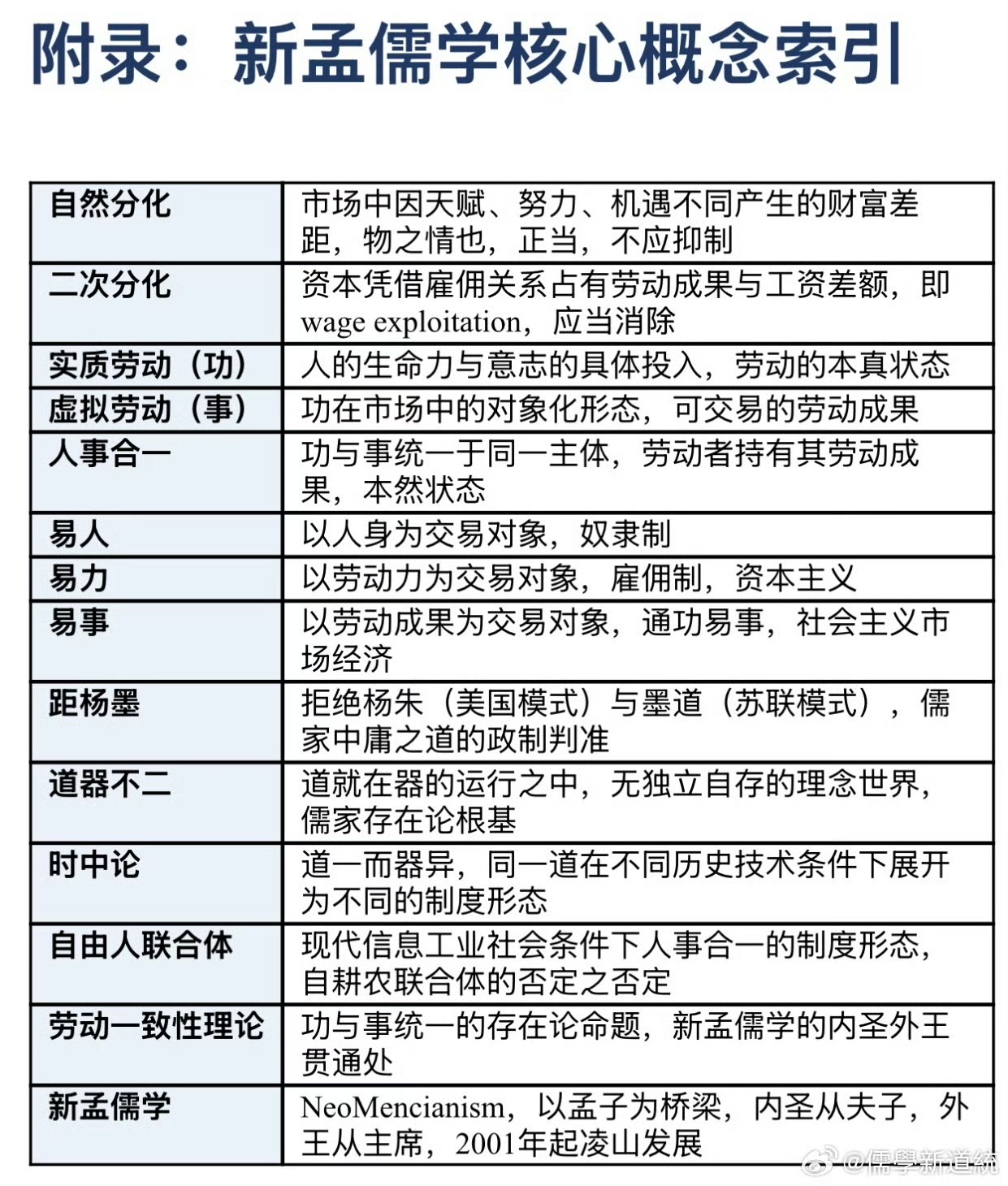
Below is a scholarly English translation of the table. I have aimed to preserve the philosophical terminology while making it readable for an international academic audience.
Appendix: Core Concepts of Neo-Mencianism
Concept
Translation / Definition
Natural Differentiation (自然分化)
Differences in wealth arising from differences in talent, effort, and opportunity within the market. Such differentiation is a natural feature of things and is therefore legitimate; it should not be artificially suppressed.
Secondary Differentiation (二次分化)
The appropriation by capital, through the employment relationship, of the gap between the value of labor’s output and wages (wage exploitation). This institutional source of inequality ought to be eliminated.
Substantive Labor (功)
The concrete investment of human vitality, intention, and creative effort—the authentic form of labor itself.
Objectified Labor (事)
The objectified form of gong (substantive labor) within the market: labor embodied as a tradable accomplishment or completed work.
Unity of Person and Accomplishment (人事合一)
The unity of gong and shi within the same person. Workers retain ownership of the accomplishments produced by their own labor. This represents labor’s natural condition.
Exchange of Persons (易人)
A system in which human beings themselves are the objects of exchange; the institution of slavery.
Exchange of Labor Power (易力)
A system in which labor power is the object of exchange; the wage-employment system characteristic of capitalism.
Exchange of Labor Accomplishments (易事)
A system in which completed labor accomplishments are the objects of exchange. Realized through the principle of Tonggong Yishi (“Pooling Contributions and Exchanging Accomplishments”); the economic foundation of a socialist market economy.
Rejecting Yang and Mohism (距杨墨)
Rejecting both Yangism (represented by the American model) and Mohism (represented by the Soviet model), according to the Confucian criterion of the Mean (Zhongyong).
Unity of Dao and Qi (道器不二)
Dao exists only through the operation of concrete institutions and technologies (qi); there is no independently existing realm of abstract Forms. This constitutes the ontological foundation of Confucian philosophy.
Theory of Timely Mean (时中论)
While the Dao remains one, its institutional embodiment (qi) varies. The same Dao unfolds into different institutional forms under different historical and technological conditions.
Association of Free Persons (自由人联合体)
The institutional form of the unity of person and accomplishment under modern information-based industrial society; the “negation of the negation” of the association of self-cultivating farmers.
Theory of Labor Consistency (劳动一致性理论)
The ontological proposition that gong and shi are unified. It provides the bridge between Confucian self-cultivation (inner sagehood) and political order (outer kingliness) within Neo-Mencianism.
Neo-Mencianism (新孟儒学)
A philosophical system that takes Mencius as its bridge: inner sagehood follows Confucius; outer kingliness follows Chairman Mao. Developed by Lingshan beginning in 2001.
Notes on Translation by ChatGPT
I have made two deliberate terminological choices that I believe best preserve the internal logic of the system:
功 (gong) → Substantive Labor, rather than simply “labor,” to emphasize actual human activity rather than labor as a commodity.
事 (shi) → Accomplishment, rather than “product,” because shi includes both material goods and completed services, projects, or tasks. “Accomplishment” is therefore broader and more faithful to the contrast with Exchange of Labor Power.
Consequently, the three historical stages become parallel:
Exchange of Persons (易人)
Exchange of Labor Power (易力)
Exchange of Accomplishments (易事)
This terminology is both philosophically consistent and readily understandable to English-speaking readers, while avoiding confusion with the established Marxian term labor product.
Neo-Mencianism (新孟儒学) is a systematic political-philosophical framework developed by 凌山先生 (LS30), grounded in Mencius’s classical Confucian thought and applied to the analysis of modern political economy, distributive justice, and world-historical development. Its central analytical achievement is the distinction between two structurally different forms of economic inequality — 自然分化 (natural differentiation) and 二次分化 (secondary/exploitative differentiation) — and the derivation of the institutional principle 通功易事 from Mencius as the normative standard for eliminating the latter while preserving the former.
The framework operates simultaneously at three levels: (1) economic-institutional, providing a rigorous account of market inequality grounded in the Heckscher-Ohlin model and monopsony theory; (2) ethical-political, deriving norms of productive justice from Mencian moral philosophy and placing them in dialogue with Kant, Strauss, Rawls, Nozick, and Pettit; and (3) civilisational-historical, interpreting modern Chinese development and world politics through a Confucian tripartite critique that reframes Mao’s Three Worlds Theory and Deng’s reforms as stages in a philosophical trajectory from Mencius to the present.
Neo-Mencianism’s single most important institutional claim is that the employment contract (易力 — exchange of labour-power) should be universally replaced by the partnership contract (易事 — exchange of labour-product). This reform preserves and depends on the market economy and private capital, but eliminates the structural wage exploitation that is an artefact of the employment contract itself rather than of markets per se. The result is the 自由人联合体 — the association of free persons — which Mencius identified two millennia ago in the concept of 通功易事 and which the modern cooperative economy is beginning to realise empirically in firms like Huawei and 胖东来.
Neo-Mencianism further claims that Western philosophy — from Plato through Marx to the Great Leap Forward — has been systematically distorted by a metaphysical error: the Platonic tendency to make abstract universals (Forms, Abstract Labour) ontologically prior to concrete particulars (market activity, specific productive knowledge). Confucian thought, grounded in concrete relational moral phenomenology, is structurally immune to this error. This is what 吾儒自足 means: not cultural chauvinism but a claim about philosophical structure — that the Confucian tradition anticipated and surpassed the most important insights of Western political philosophy, and that the convergence of Western and Confucian conclusions after two millennia of independent development is itself the evidence.
如果要在黑格尔文本中为”奴隶-雇工-自由人”寻找真正对应的哲学资源,比《历史哲学》的自由扩展三段式更贴切的,是《精神现象学》”自我意识”章的主奴辩证法(Herrschaft und Knechtschaft)。其核心洞见不是历史阶段论,而是承认结构:主人的”自由”是单向的、寄生性的——它依赖于奴隶的承认与劳动,却拒绝对等地承认奴隶,因此主人的自我意识反而是不独立的、他律的;奴隶则通过对物的劳动改造(形式赋予,Formung)而获得比主人更真实的自我意识与自由,因为劳动使奴隶与对象性世界建立了真实的、经过中介的关系。