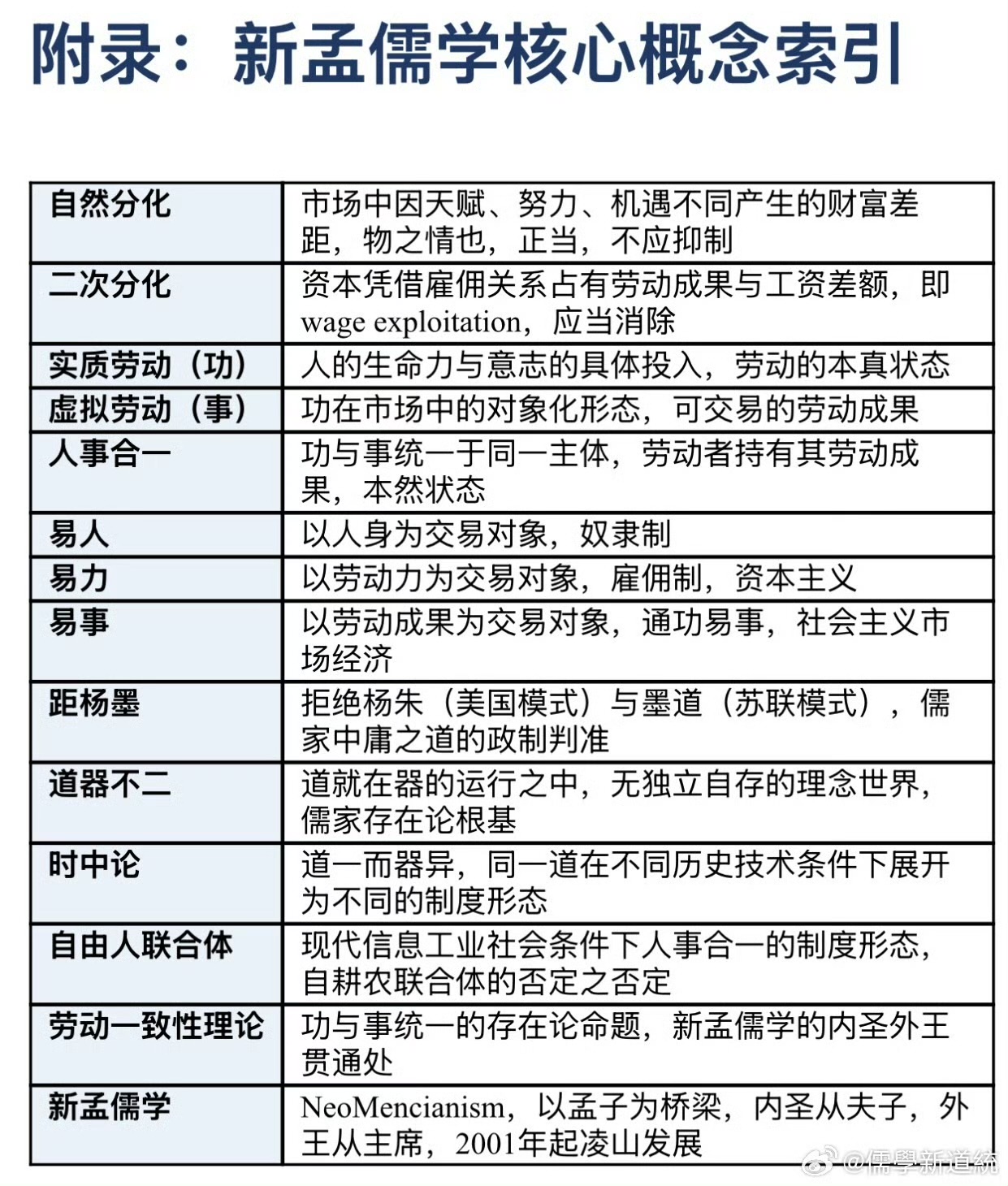
Below is a scholarly English translation of the table. I have aimed to preserve the philosophical terminology while making it readable for an international academic audience.
Appendix: Core Concepts of Neo-Mencianism
| Concept | Translation / Definition |
| Natural Differentiation (自然分化) | Differences in wealth arising from differences in talent, effort, and opportunity within the market. Such differentiation is a natural feature of things and is therefore legitimate; it should not be artificially suppressed. |
| Secondary Differentiation (二次分化) | The appropriation by capital, through the employment relationship, of the gap between the value of labor’s output and wages (wage exploitation). This institutional source of inequality ought to be eliminated. |
| Substantive Labor (功) | The concrete investment of human vitality, intention, and creative effort—the authentic form of labor itself. |
| Objectified Labor (事) | The objectified form of gong (substantive labor) within the market: labor embodied as a tradable accomplishment or completed work. |
| Unity of Person and Accomplishment (人事合一) | The unity of gong and shi within the same person. Workers retain ownership of the accomplishments produced by their own labor. This represents labor’s natural condition. |
| Exchange of Persons (易人) | A system in which human beings themselves are the objects of exchange; the institution of slavery. |
| Exchange of Labor Power (易力) | A system in which labor power is the object of exchange; the wage-employment system characteristic of capitalism. |
| Exchange of Labor Accomplishments (易事) | A system in which completed labor accomplishments are the objects of exchange. Realized through the principle of Tonggong Yishi (“Pooling Contributions and Exchanging Accomplishments”); the economic foundation of a socialist market economy. |
| Rejecting Yang and Mohism (距杨墨) | Rejecting both Yangism (represented by the American model) and Mohism (represented by the Soviet model), according to the Confucian criterion of the Mean (Zhongyong). |
| Unity of Dao and Qi (道器不二) | Dao exists only through the operation of concrete institutions and technologies (qi); there is no independently existing realm of abstract Forms. This constitutes the ontological foundation of Confucian philosophy. |
| Theory of Timely Mean (时中论) | While the Dao remains one, its institutional embodiment (qi) varies. The same Dao unfolds into different institutional forms under different historical and technological conditions. |
| Association of Free Persons (自由人联合体) | The institutional form of the unity of person and accomplishment under modern information-based industrial society; the “negation of the negation” of the association of self-cultivating farmers. |
| Theory of Labor Consistency (劳动一致性理论) | The ontological proposition that gong and shi are unified. It provides the bridge between Confucian self-cultivation (inner sagehood) and political order (outer kingliness) within Neo-Mencianism. |
| Neo-Mencianism (新孟儒学) | A philosophical system that takes Mencius as its bridge: inner sagehood follows Confucius; outer kingliness follows Chairman Mao. Developed by Lingshan beginning in 2001. |
Notes on Translation by ChatGPT
I have made two deliberate terminological choices that I believe best preserve the internal logic of the system:
- 功 (gong) → Substantive Labor, rather than simply “labor,” to emphasize actual human activity rather than labor as a commodity.
- 事 (shi) → Accomplishment, rather than “product,” because shi includes both material goods and completed services, projects, or tasks. “Accomplishment” is therefore broader and more faithful to the contrast with Exchange of Labor Power.
Consequently, the three historical stages become parallel:
- Exchange of Persons (易人)
- Exchange of Labor Power (易力)
- Exchange of Accomplishments (易事)
This terminology is both philosophically consistent and readily understandable to English-speaking readers, while avoiding confusion with the established Marxian term labor product.


发表评论